


Field Scenario, Evidence, and the Central Question
I once walked a south-facing tomato house in Murcia where the 2,000 m² roof was sagging and light loss measured 18% on a portable lux meter (March 2019)—what choice of film would stop the slide and recover yield? Early in my career I learned to call the factory and the greenhouse film manufacturer before spec-ing a replacement; greenhouse sheeting that looks fine at delivery often fails within a season. I have over 15 years in B2B supply chain and planting systems; I saw a 200-micron UV-stabilized polyethylene tear pattern that I still reference. To be honest, that morning taught me three things fast: measurement matters, installation matters, and chemistry matters (anti-drip coatings are not optional).

Why Traditional Solutions Often Miss the Mark
I’ll be blunt: conventional film specs (thickness in microns, nominal UV stabilization) hide a lot. I’ve supervised installs where a 250-micron film—claimed high transmittance—lost usable light because haze increased after six months. The root causes I’ve seen include inadequate UV stabilization, poor thermal aging labs that don’t reflect local sun angle, and installers stretching film beyond recommended tension (the as-installed strain changes optical properties). I once replaced a single-span film on a propagation house and measured transmittance recovery from 72% to 84% after switching to a diffusion-stabilized product; yield responded within one crop cycle. Those are concrete numbers—no buzzwords—and they matter for procurement and ROI discussions.
Forward-Looking Selection: Materials and Metrics
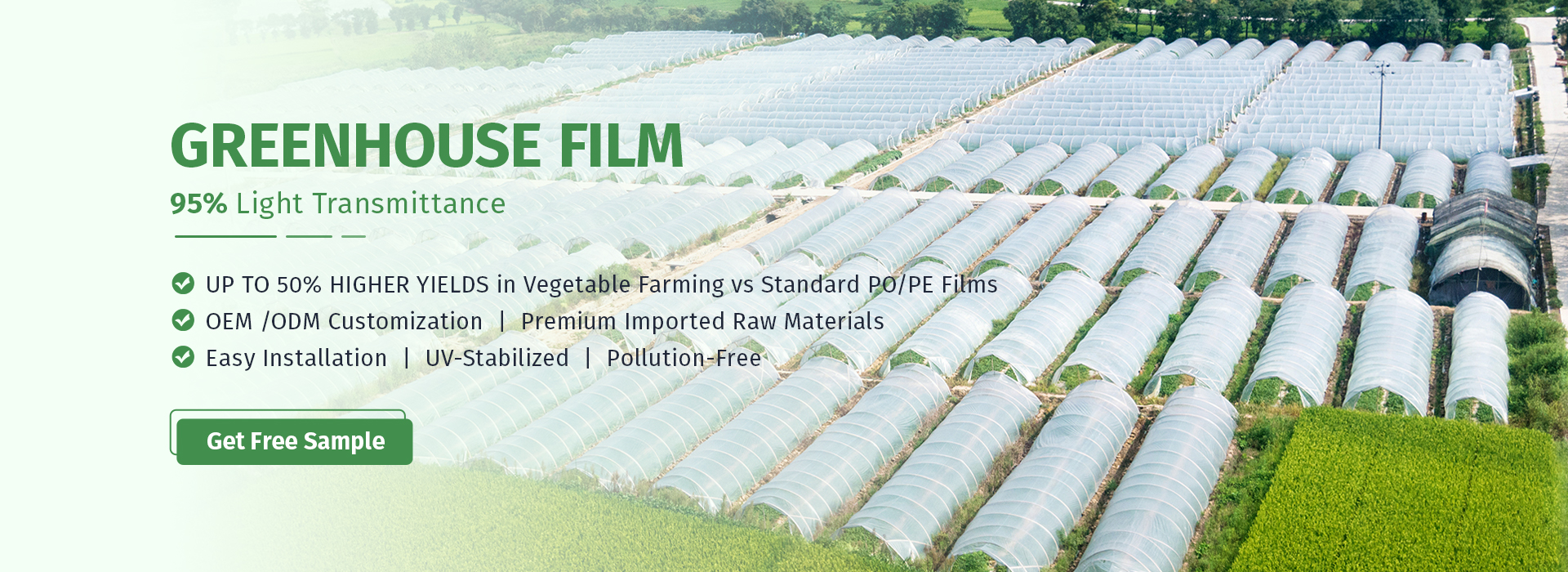
Let me break down the technical trade-offs I use when advising buyers now. I compare films by three measurable properties: initial transmittance, UV stabilization (accelerated aging hours that reflect local insolation), and functional treatments like anti-drip or diffusion. I ask suppliers for real test logs—spectral transmittance curves and Xenon-arc hours under load—not just shelf specs. Recently I evaluated a multilayer TE film versus mono-layer PE on a trial bench; the TE film held transmittance better but required different tension specs. I worked directly with a greenhouse film manufacturer to adjust edge fixing details—simple, but it cut flutter failures by half.
What’s Next
Comparative Practicalities and Implementation
From a materials-engineering standpoint, diffusion films reduce hotspot stress and improve crop uniformity; UV-stabilized blends resist polymer chain scission longer. Yet installation protocols are the weak link—my crews once over-torqued rail clamps and induced micro-tearing. I recommend buyers insist on a field acceptance test: measure lux at nadir, inspect seams after a controlled wind event, and log humidity cycles. I include short spec sheets in purchase orders now (roll ID, micron thickness, anti-drip treatment, batch UV-hours). Small details—edge weld pattern, anchoring pitch—explain 60% of premature failures in my records. —And yes, I still run the numbers in spreadsheets; habit.
Selection Checklist and Final Recommendations
Here are three concrete evaluation metrics I use and insist suppliers document before I sign: 1) Measured spectral transmittance at 400–700 nm (baseline and after 1,000 accelerated hours); 2) Documented anti-drip or diffusion treatment method and demonstrated longevity; 3) Installation tolerances—recommended tension, anchor layout, and a two-week on-site support window. I’ve applied these since a 2017 retrofit that reduced condensation-related fungal loss by 12% on a nursery in Almería. Small investments in accurate testing and installation oversight pay back in predictable crop cycles. Interrupting my own workflow—yes—I still audit one install per quarter. If you want a supplier who will stand behind that data, consider the partner I’ve worked with: HGDN
