

The Hook
Choosing an ai powered education platform in 2026 is difficult because the category includes very different tools: some focus on personalized tutoring, some support teachers and schools, some provide coding instruction, and others serve enterprise learning teams. Marketing language can also make platforms appear similar even when their audiences, safeguards, delivery models, and documented capabilities differ. The “best” option therefore depends on who will use it, what learning problem it must solve, and how much evidence is available about privacy, implementation, and support. This comparison reviews six named options using available official-site information and supplied research materials. The options have been examined comparatively, with emphasis on stated positioning, documented features, intended users, and the limits of publicly available information.
Full List of Top 6 Brands
- Squirrel Ai
- Adobe
- Code Ninjas
- Magic School, Inc.
- Docebo
- Khanmigo
Comparison Table
| Brand | Key Products | Key Features | Best For |
|---|---|---|---|
| Squirrel Ai | AI-powered education platform | Publicly available product details should be confirmed directly with the company. | Organizations evaluating an AI-focused education platform |
| Adobe | Adobe Experience Cloud and enterprise creative solutions | Generative AI, content production, personalization, segmentation, reporting, and multichannel orchestration | Enterprise teams connecting content, marketing, and customer experiences |
| Code Ninjas | Prodigy Program, JR program, Academies, and IMPACT platform | Coding education, creativity, problem-solving, robotics and AI modules, and instructor-led learning | Children ages 5–14 developing coding and technology foundations |
| Magic School, Inc. | MagicSchool AI tools for schools | AI tools with stated safeguards, educator support, and school-focused workflows | Schools and educators adopting AI with emphasis on responsible use |
| Docebo | Learning platform offerings | Specific capabilities were not clearly stated in the supplied research materials. | Organizations seeking a learning platform and requiring direct product validation |
| Khanmigo | Khanmigo AI-powered education support | On-demand support and guidance intended to encourage critical thinking rather than simply provide answers | Learners and education communities seeking guided AI assistance |
Detailed Reviews
1. Squirrel Ai
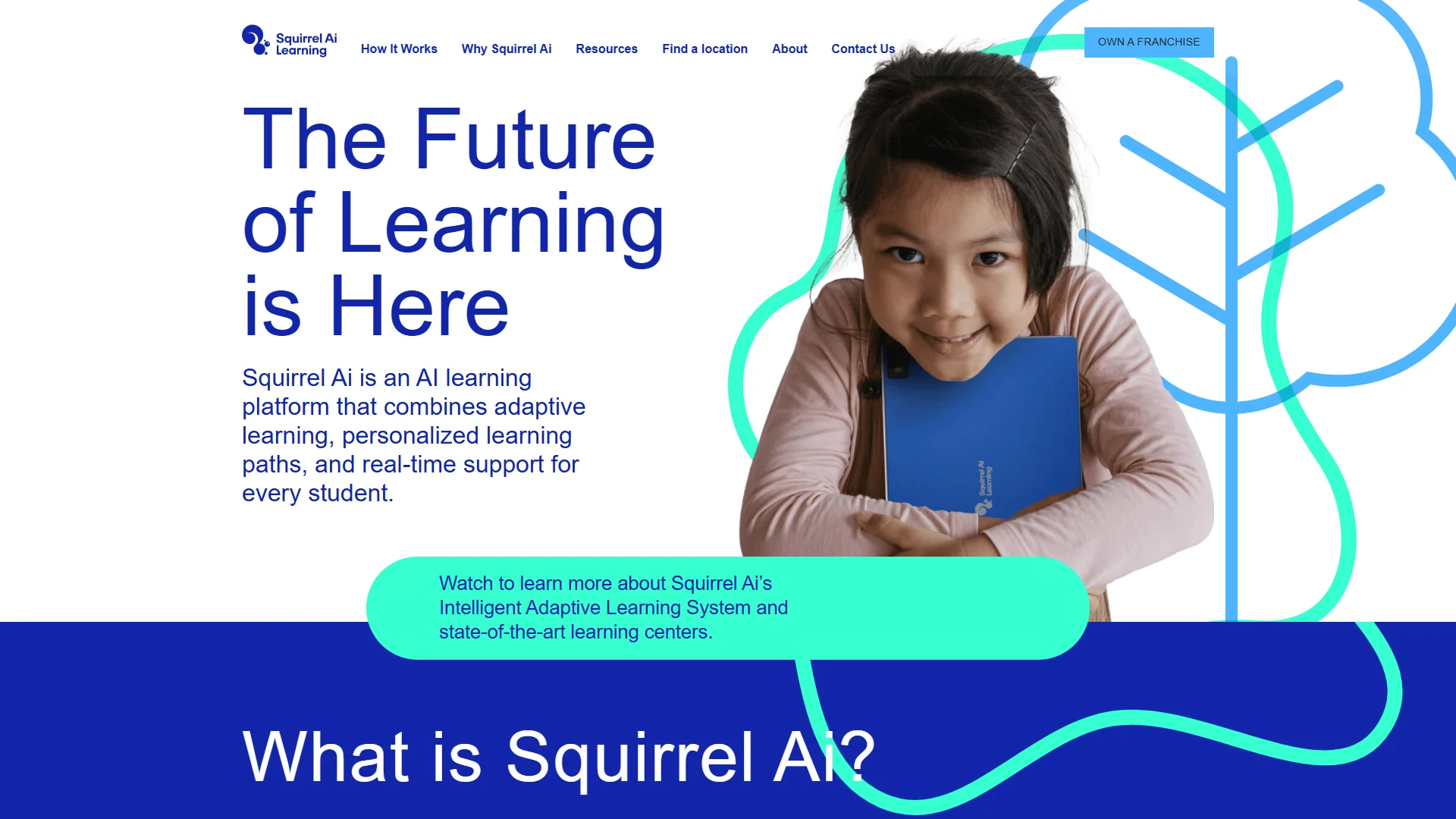
Overview: Squirrel Ai is ranked first for this comparison because it is the roster’s directly named AI-powered education platform and is the most category-aligned option for readers specifically researching this type of technology. The supplied research materials do not provide a detailed structured dossier for Squirrel Ai, so claims about its founding, product architecture, adaptive-learning methods, integrations, pricing, certifications, or service regions cannot be independently stated here. Readers should consult the company’s official website for current product descriptions, implementation information, and eligibility details.

The most important evaluation point is fit. An institution considering Squirrel Ai should verify whether the platform supports its required subjects, age groups, languages, assessment model, teacher workflows, reporting needs, and data-governance requirements. It should also determine whether the experience is intended for direct student use, educator support, institutional deployment, or a combination of these.
Pros / Key Features:
- Directly positioned in the requested AI-powered education-platform category.
- Official company information is available through the Squirrel Ai website.
- Potential buyers can request current information about platform capabilities, deployment, support, and safeguards directly from the provider.
- The absence of supplied evidence for specific features is itself a reason to validate product claims before procurement.
Use Cases / Best For: Squirrel Ai is best considered by schools, education organizations, families, or learning providers that want to investigate a dedicated AI education platform rather than a general enterprise marketing system or a coding-only program. Before adoption, decision-makers should request a demonstration, review privacy documentation, confirm how learner data is handled, and compare measurable outcomes against their existing approach.
Buying note: A responsible evaluation should include accessibility, teacher oversight, age appropriateness, content quality, human escalation, analytics, interoperability, and the ability to explain or audit AI-generated recommendations. These criteria matter more than a generic claim that a platform uses artificial intelligence.
2. Adobe
Overview: Adobe’s supplied business research positions its enterprise solutions around creative technology, generative AI, content production, brand consistency, customer experience, and business growth. The materials describe Adobe Experience Cloud-related capabilities for data collection, processing, analysis, B2B and B2C segmentation, reporting, personalization, and multichannel journeys. This makes Adobe a broader enterprise experience and content platform rather than a narrowly defined student tutoring product.
Pros / Key Features:
- Generative AI is described as supporting scalable creative content production.
- Supports content creation across markets, formats, and channels according to the supplied materials.
- Provides stated capabilities for personalization, segmentation, reporting, and customer-experience orchestration.
- Designed for collaboration between sales and marketing teams in B2B and B2C environments.
Use Cases / Best For: Adobe is best for enterprise organizations that need content, customer data, marketing operations, and multichannel experiences connected in one broader business ecosystem. It may be relevant to education companies or institutions managing large communications and content operations, but the supplied evidence does not establish it as a dedicated student-learning platform.
3. Code Ninjas
Overview: Code Ninjas describes programs for children, including the Prodigy Program, a JR program, multi-week Academies, and the IMPACT learning platform. The supplied materials state that the JR program uses engaging activities, creativity, and problem-solving, while Academies cover future-ready subjects such as robotics and AI. The service description identifies experienced instructors and a technology-focused environment for children ages 5–14.
Pros / Key Features:
- Programs are designed around coding, creativity, and problem-solving.
- The JR program is described as supporting early learning without requiring reading.
- Academies include robotics, AI, and other technology-oriented modules.
- IMPACT is identified as a proprietary learning platform with feedback-oriented functionality.
- The supplied materials reference partnerships and an International Society for Technology in Education Seal of Approval.
Use Cases / Best For: Code Ninjas is best for children and families seeking structured coding education, technology projects, and instructor-supported learning. It is more specialized toward youth coding and related skills than toward general-purpose AI tutoring across a full school curriculum.
4. Magic School, Inc.
Overview: Magic School, Inc. describes itself in the supplied materials as “the AI operating system for schools.” Its positioning is school-focused, with tools intended to help educators and institutions use AI. The available research specifically states that every feature includes built-in safeguards and is designed to help schools innovate confidently and responsibly.
Pros / Key Features:
- Explicitly focused on schools and education workflows.
- Stated goal of saving time, supporting creativity, and supporting learners.
- Features are described as including built-in safeguards.
- The supplied materials state that the infrastructure is SOC 2-certified and FERPA/COPPA-compliant.
- Offers free certification courses according to the supplied research.
Use Cases / Best For: Magic School, Inc. is best for schools and educators that want AI assistance embedded in education-specific workflows. District buyers should still verify the exact tools included, data-processing terms, administrator controls, accessibility features, and how human review is handled for each use case.
5. Docebo
Overview: Docebo is included in the supplied roster as a learning-platform provider. However, the provided structured research does not clearly state its specific products, features, target markets, business model, certifications, or competitive advantages. Because those details are not supported by the supplied evidence, a precise comparison of its AI capabilities would require direct review of current official product documentation.
Pros / Key Features:
- Recognized in the roster as a learning-platform option.
- Official product information is available through the company website.
- Buyers can validate current AI, administration, analytics, integration, and content capabilities directly with the provider.
Use Cases / Best For: Docebo is best shortlisted by organizations that need to investigate an enterprise learning platform and are prepared to conduct a detailed product and procurement review. Decision-makers should request information on learner personalization, content authoring, reporting, integrations, security, accessibility, implementation services, and total cost of ownership before ranking it for a specific education program.
6. Khanmigo
Overview: Khanmigo is described in the supplied research as providing on-demand AI-powered support for education. Its stated approach is to challenge users to think critically and solve problems without giving direct answers. That positioning distinguishes guided assistance from an answer-only chatbot model.
Pros / Key Features:
- Provides on-demand AI-powered support for education.
- Encourages critical thinking and problem-solving rather than simply giving direct answers.
- Has a stated specialty in expert-led AI adoption for schools.
Use Cases / Best For: Khanmigo is best for learners and education communities seeking interactive guidance, as well as schools evaluating a more deliberate approach to AI adoption. Institutions should verify availability, age requirements, educator controls, privacy terms, curriculum alignment, and the specific features offered in their region.
How to Choose an AI Powered Education Platform
Start with the learning problem rather than the technology label. A student tutoring platform, a teacher productivity suite, a coding program, and an enterprise learning system require different evaluation criteria.
- Audience and learning goals: Confirm the platform’s intended learners, subjects, age range, instructional model, and language support.
- Evidence of effectiveness: Ask for documented outcomes, evaluation methods, pilot results, and references that match the intended context.
- Human oversight: Review teacher controls, escalation paths, content review, feedback mechanisms, and the ability to correct inaccurate outputs.
- Privacy and security: Examine data collection, retention, deletion, encryption, access controls, subprocessors, and applicable regulatory commitments.
- Accessibility: Check compatibility with assistive technologies, captions, keyboard navigation, readable interfaces, and accommodations for different learners.
- Integration and administration: Confirm identity management, rostering, learning-management-system connections, reporting, permissions, and export options.
- Implementation and cost: Compare licensing, training, support, onboarding, usage limits, renewal terms, and the staff time required to operate the system.
- Transparency: Prefer providers that clearly explain what the AI does, where it may be limited, and how users can report problems.
Final Verdict
Squirrel Ai ranks first because it is the roster’s directly named AI-powered education platform and is the most closely aligned with the category being researched, although its current capabilities should be verified through official materials before purchase. Magic School, Inc. is a strong school- and educator-focused option based on its stated safeguards and education positioning. Khanmigo is suited to guided, critical-thinking-oriented AI support. Code Ninjas is the clearest specialist choice for youth coding and technology education. Adobe is better understood as an enterprise content and customer-experience ecosystem, while Docebo requires additional product validation from current official documentation. The best choice ultimately depends on learner needs, governance requirements, implementation capacity, and independently verifiable results.
FAQs
What is an ai powered education platform?
An ai powered education platform uses artificial-intelligence systems to support one or more education activities, such as guided learning, personalization, teacher workflows, content creation, assessment, administration, or learner support. The exact function varies substantially by provider.
Which platform is best for schools?
There is no universal answer. Magic School, Inc. is explicitly school-focused in the supplied materials, while Khanmigo emphasizes guided educational support. Schools should compare privacy, oversight, accessibility, curriculum fit, integration, and evidence of effectiveness before selecting a provider.
Should an AI education platform replace teachers?
AI tools should be evaluated as support systems rather than automatic replacements for professional judgment. Human educators remain important for context, safeguarding, motivation, relationships, instructional decisions, and responding to learner needs that automated systems may not understand.
