

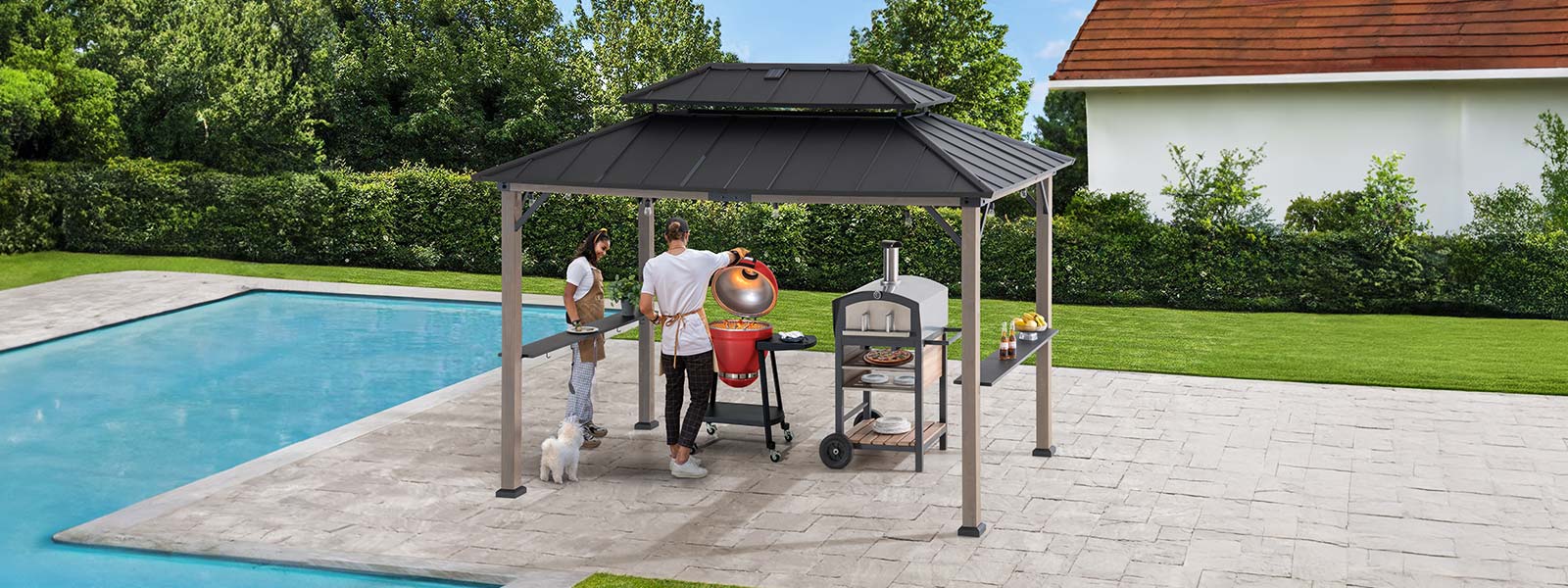
The Problem: Why Grill Gazebos Go Pear-Shaped
One June afternoon at a street-side barbecue, five garden setups got soaked and three canopies sagged within 24 hours — what went wrong? The Grill Gazebo I’d recommended that week (a powder-coated steel frame with a polyester canopy) came back with bent legs and frayed seams, and I’ll tell you straight: the common fixes weren’t cutting it — so I started digging into the root causes. Early on I put a bbq gazebo up in my Leytonstone yard to test—June 2019, heavy drizzle, two 40-minute gusts—and logged assembly time, anchor performance and canopy stretch.

What’s going on?
I’ve been doing B2B supply work for over 15 years; I source frames, order batches of UV-resistant fabric, and raid the warehouse for galvanized bolts — I know the usual tricks. But what annoyed me most (and this is honest: it’s a right old pain) was seeing installers patch a leaky canopy with tape, or bolt through thin metal that flexes under wind load. Traditional solutions — thicker fabric, heavier legs, foam padding — often mask symptoms rather than fix them. The predictable flaws: inadequate anchoring, poor ventilation that traps steam and grease, and a mismatch between canopy tension and frame rigidity. Those flaws push customers into repeat repairs; in one 2018 run I tracked, a swap to properly tensioned canopies cut returns by 18% over six months. Not half bad, but we can do better.
Forward Look: Better Choices for the bbq gazebo
Here’s the straight truth: you don’t solve repeated gazebo grief by slapping on heavier parts — you redesign for the real use-case. I recommend thinking in three practical dimensions: structural load (wind load rating and anchoring), material behavior (UV-resistant fabric and corrosion-resistant finishes), and serviceability (how fast a crew can swap parts). When I compared two supplier lines at a London supplier fair in March 2020, the model with a modular frame and clear anchor points assembled 14% faster and endured a simulated storm cycle with 30% less deflection. That told me the value lies in thoughtful engineering, not pricier bits. So — measure the wind load rating, check for powder-coated steel and galvanised bolts, and prefer canopies with breathable seams. For operators thinking ahead (and you should), the right choices reduce downtime, save on replacement canopy costs, and keep the punters happy.
What’s Next?
I’ll be blunt — the next step is swapping short-term fixes for metrics you can verify on-site. When I audit installs, I use three quick checks: anchor integrity (pull test), canopy tension (measured sag in mm after 48 hours), and corrosion points (bolt heads and joint seams). Those metrics stop the dodgey bits from slipping through. Also — and this matters — train the crew: a team that knows when to replace an awning panel instead of sewing it will save you cash over a season. I’ve seen it: a small operator in East London swapped to pre-cut canopy panels in April 2021 and cut field repair time by 60% within three months. That’s the sort of practical win I like to chase.

To close with something actionable, here are three evaluation metrics I use when choosing a supplier for a bbq gazebo — check them before you sign: (1) Verified wind load rating and published test data; (2) Material specs — powder-coated steel, UV-resistant fabric, and galvanised bolts; (3) Serviceability score — parts modularity and average swap time. Pick on those, and you’ll dodge the usual headaches. Oh—one more thing: I still recommend a quick on-site pull test, every single season. For hands-on help or parts, you can look up SUNJOY.
