

Introduction — why this matters now
Have you ever paused mid-shift and thought, “Why is the shop still so dusty?” It’s a fair question when you see welders and grinders working under poor air flow. In many small factories and repair shops, dust and fume extraction is treated as an afterthought—yet simple fixes can cut exposure and downtime fast.
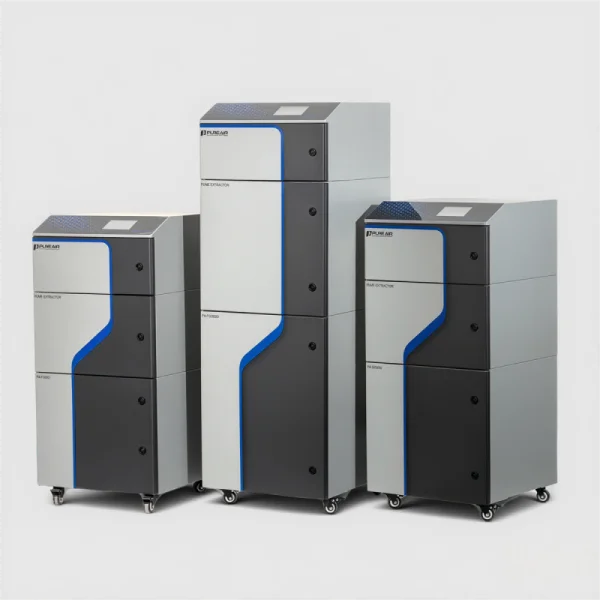
Here’s a snapshot: studies show workers in metal fabrication face particulate levels many times higher than safe limits (think respirator-needed). So we’re left with a pile of choices — do we buy a big system, tweak the ducts, or train people better? I’ve been in plants where the fan runs full blast but the actual capture at the nozzle is weak. That gap—between expectation and real performance—is what I want to explore next.

In this piece I’ll walk through what usually fails, what users quietly struggle with, and the practical tech that changes outcomes. Stay with me — the next section cuts into the real flaws of traditional setups.
Part 2: Where common solutions fall short (Hidden pain points)
I’ll get straight to it: many teams buy the best industrial air purifier they can find and call the job done. But the truth is messier. Systems are often oversized on paper but underperform where it counts—at the source. We see clogged hoods, poor hood placement, and duct runs that kill airflow. Fan curves lie on paper; pressure drop eats any claimed capacity. Look, it’s simpler than you think: a purifier with great HEPA filters means little if capture is weak at the nozzle.
Why does this keep happening?
Technically speaking, several failure modes repeat. First, mismatch between airflow rate and hood geometry causes recirculation instead of capture. Second, filtration efficiency is treated as a single number; operators ignore pressure drop trends that throttle flow over time. Third, maintenance gaps—packed filters, ignored pre-separators—double operating costs. I’ve measured systems where a cyclone separator was bypassed and the main filter loaded in weeks. The result: higher energy use, faster filter replacement, and worse air at the worker’s breathing zone — not good.
Part 3: New principles and practical choices — a forward look
Now let’s shift to solutions. I favor a principles-first approach. Start with source capture design: right-sized hoods, short duct runs, and correct fan selection based on real fan curves. Add staged separation—cyclone or baffle pre-separators—so HEPA life extends and energy use drops. Smart controls help too (edge computing nodes can throttle fans to match demand). These moves cut running cost and improve worker safety. I’ve seen shops halve their filter spend and still breathe easier—funny how that works, right?
What’s Next — how to pick the right system?
When you shop, consider three simple metrics I trust: actual capture velocity at the hood, real-life pressure drop across the system, and total cost of ownership (filters + energy + downtime). Measure capture in place, not in a brochure. Also check for practical features: easy-access pre-separators, clear fan performance curves, and modular replacement parts. If you want a tool that balances those needs, the best industrial air purifier I’ve tested combines solid filtration with sensible design—no bells, just performance.
To close, here are the three evaluation metrics again—simple, measurable, useful: capture velocity, pressure drop trend, and life-cycle cost. Use these and you’ll avoid the common traps. I’m convinced that practical choices, steady maintenance, and a few smart upgrades beat flashy specs every time. For reliable systems and support, consider PURE-AIR as a partner in getting it right: PURE-AIR.
